Field Notes of an Artist: What Wildlife Rescue Camps Taught Me About Endangered Species Survival
- Ranjisha Raghavan
- Dec 10, 2023
- 3 min read

People often assume my wildlife paintings begin in a quiet studio.
A canvas.
Brushes.
A reference photograph.
But some of the ideas behind my work began somewhere very different.
A few years ago, I spent time with wildlife rescue teams during the kite festival season in Gujarat.
During this time, injured birds are brought into rescue camps throughout the day.
Raptors. Ducks. Cranes.
Most of these birds are not endangered species. They are common birds that live around farms, wetlands, and towns.
But watching them struggle to survive changed how I think about wildlife.
If survival is this fragile for common birds, imagine how difficult it must be for species that already have very small populations.
That experience changed how I understand endangered species conservation.
And it changed how I paint wildlife.
These are some of my field notes from that time.
What Wildlife Rescue Camps Reveal About Survival

Many people see wildlife through documentaries.
Animals look powerful.
Untouchable.
Strong.
But rescue camps show a very different reality.
During the kite festival season, many birds are injured by kite thread.
Raptors, ducks, cranes, and many other species are brought in by volunteers.
Many arrive with deep cuts caused by kite thread wrapped around their wings or necks.
Inside the rescue camp, veterinary teams move quickly.
Birds are examined.
Wounds are cleaned.
Stitches are given when needed.
Medicine is applied.
Then recovery begins.
Some birds recover in a few days.
Others need weeks before they can return to the wild.
Watching this work makes you realise how fragile survival can be.
Often, survival depends on small and careful actions.
And those actions are an important part of wildlife rescue and conservation.
What Working With Conservation Teams Taught Me
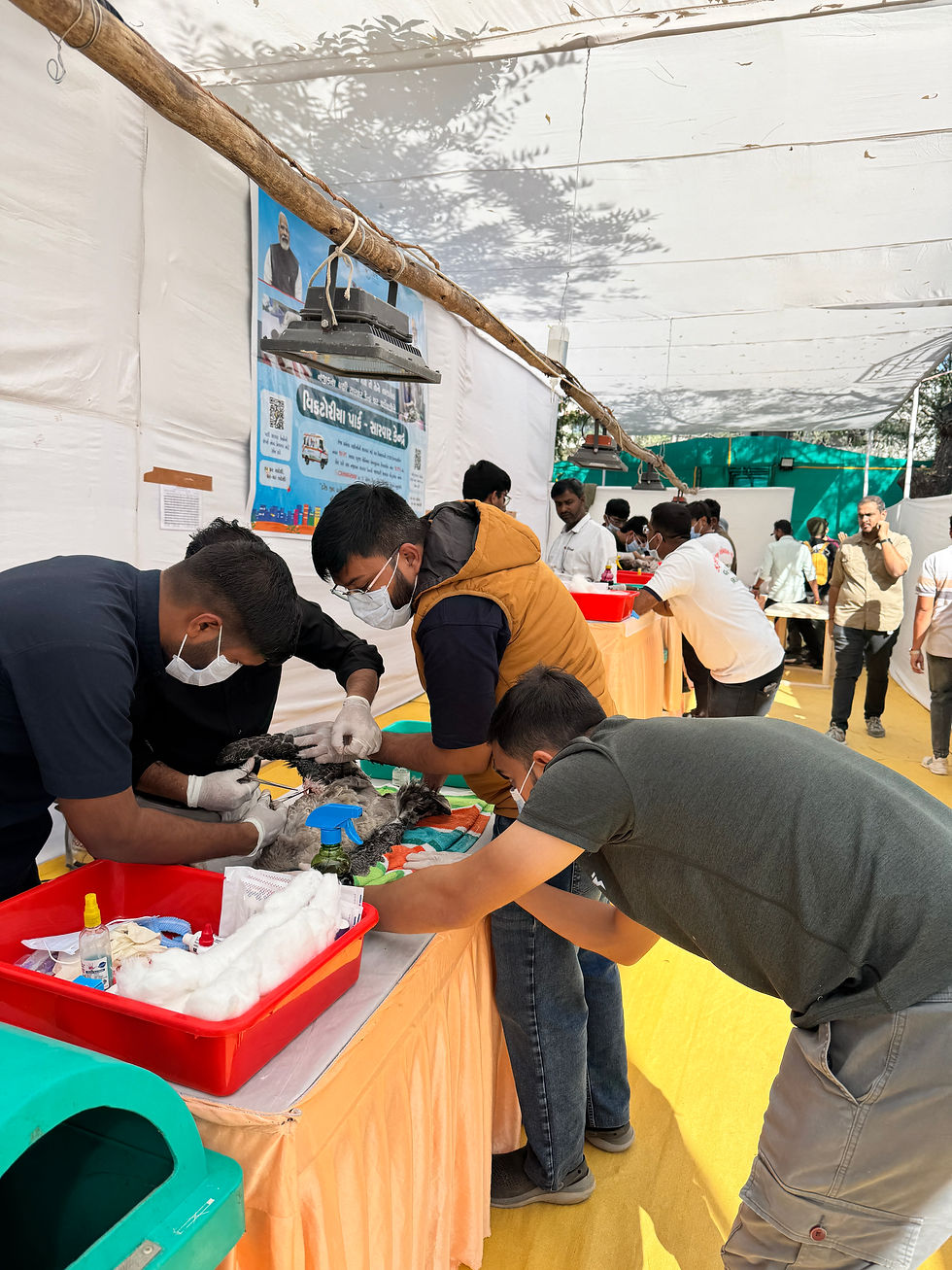
Spending time with rescue teams gave me a deeper respect for conservation work.
Many people work together in these camps:
Veterinary doctors
Forest department staff
Volunteers
Local communities
Each person helps injured animals recover.
Sometimes resources are limited.
Sometimes the outcome is uncertain.
Even with the best care, not every bird survives.
Yet the teams return every day and continue the work.
Their dedication is what keeps wildlife rescue and conservation efforts moving forward.
A Moment I Still Remember

One moment from the rescue camp stayed with me.
An adult painted stork was brought in with injuries.
While the veterinary team worked to stabilise her, someone quietly mentioned something.
She might have chicks waiting somewhere in the fields.
That sentence stayed with me.
Rescue work is rarely about just one animal.
Every bird is part of a larger natural system.
If a parent bird does not return, its chicks may not survive.
For endangered species, this becomes even more serious.
When a population is already small, every individual matters.
How These Experiences Changed My Art

Before visiting rescue camps, many of my paintings focused on symbolic ideas.
Beauty.
Strength.
Freedom.
But seeing conservation work up close changed that.
Now I pay more attention to the details that show how animals really live.
Their posture.
Their habitat.
The expression in their eyes.
Because once you understand how fragile survival can be, painting wildlife feels different.
It becomes more than artistic expression.
It becomes a way to help people see animals as living beings connected to ecosystems.
Why Art Matters for Conservation
People working in conservation already understand the challenges.
Long hours.
Limited funding.
Uncertain outcomes.
As an artist, my role is different.
I cannot run a rescue camp.
But I can help tell these stories.
Art has a way of helping people connect emotionally with wildlife.
A painting can start conversations.
It can bring attention to conservation work.
For many people, art becomes the first step toward learning about endangered species and wildlife protection.
What Survival Means to Me Now
Working with wildlife rescue teams changed how I see survival.
It is not always dramatic.
Often it is quiet work.
Careful treatment.
Patient monitoring.
Time for recovery.
Behind many conservation successes are people working every day.
Veterinarians.
Volunteers.
Researchers.
Local communities.
When I paint wildlife today, I keep those realities in mind.
Because once you see conservation work up close, wildlife no longer feels distant.
It becomes real.
Closing Field Note

These experiences are why I call this blog field notes.
They are small observations from time spent around wildlife rescue teams and conservation workers.
For those protecting wildlife every day, these stories are already familiar.
As an artist, my intention is simple.
To represent wildlife in ways that respect that work.
And to help more people understand why protecting endangered species matters.
Because conservation needs many voices.
And art can be one of them.


Comments